In Norman Foster’s work, architecture does not appear as a formal discipline, but as the result of a widely branched mode of thinking. “Networks” makes this structure visible – not as a theory in the classical sense, but as a precise cartography of influences and decisions.
From Object to System
Rarely does Foster write so directly about himself as in this book. “Networks” is not a monograph in the usual sense, but a collection of essays that lay bare his own design process. Categories such as “Roots,” “Flight,” “Nature,” or “Cities” structure the material without organizing it – they connect it into an open context.
At the center lies a shift: buildings lose their autonomy in favor of a way of thinking in relations. Foster does not describe architecture as an isolated achievement, but as the result of continuous interconnections between technology and landscape. “Everything inspires me” appears here less as a gesture than as an operative stance.
This logic continues in the presentation. Foster does not develop an abstract theory, but works through observation. Sketches and diagrams take on the role of concepts. The book thus resembles more a working instrument than a volume of essays. It shows not only ideas, but also their emergence. Drawing becomes a method.
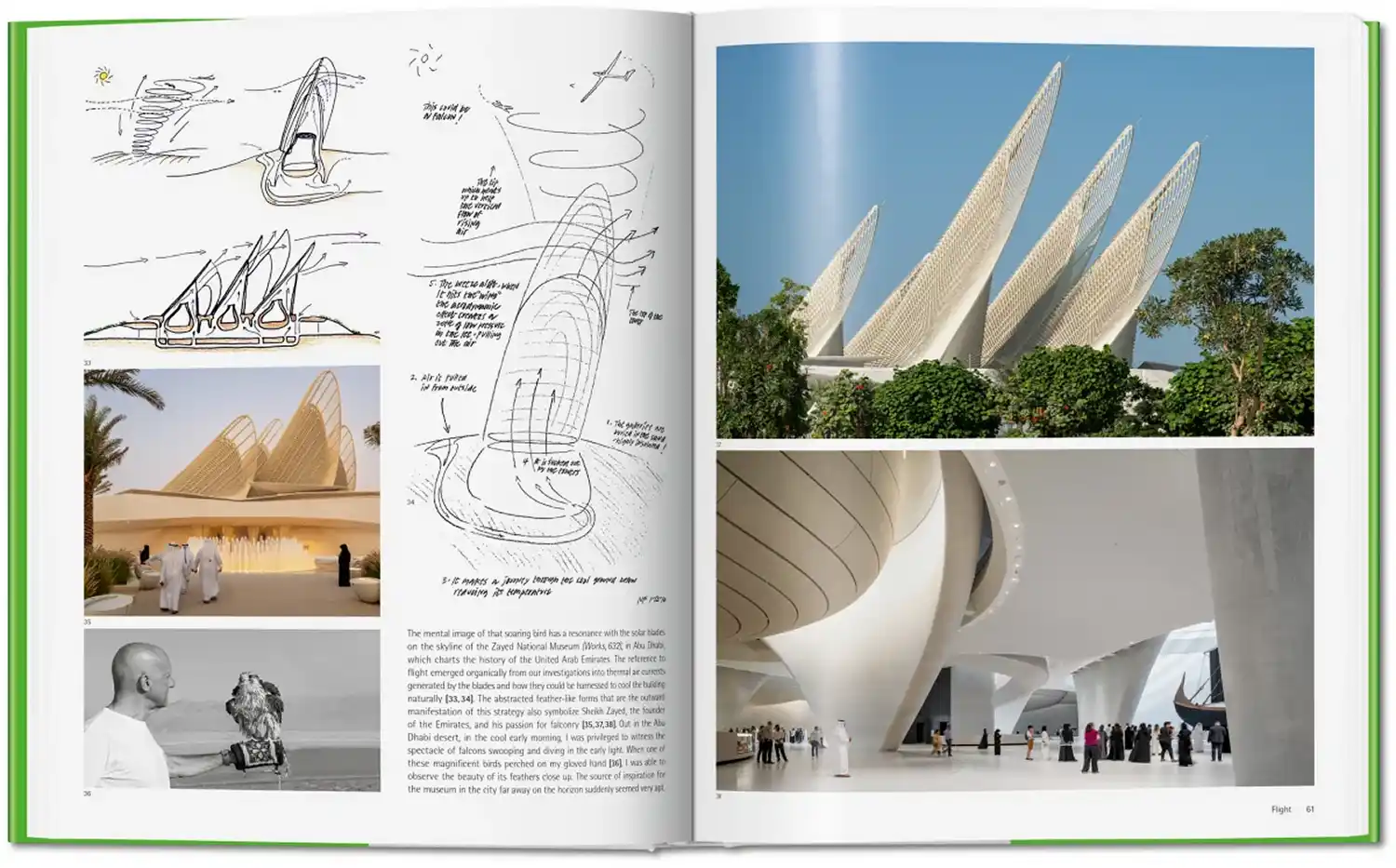
Photo: TASCHEN
Modernity as Continuity
Architecture appears as an integrative practice that does not define itself through ruptures. Past and future stand in a continuous relationship to one another. Foster describes design as working “for the present, with awareness of the past and for an unknown future.”
This perspective also changes the definition of innovation. Innovation does not arise from separation, but from connection. Technical and ecological aspects are not placed side by side, but are translated into one another. Architecture thus becomes a form of organizing complex interrelations.
This is precisely where the strength of the book lies. The projects do not appear as individual works, but as part of a larger structure in which different disciplines and influences converge. The built form is not the starting point, but the result of this condensation.
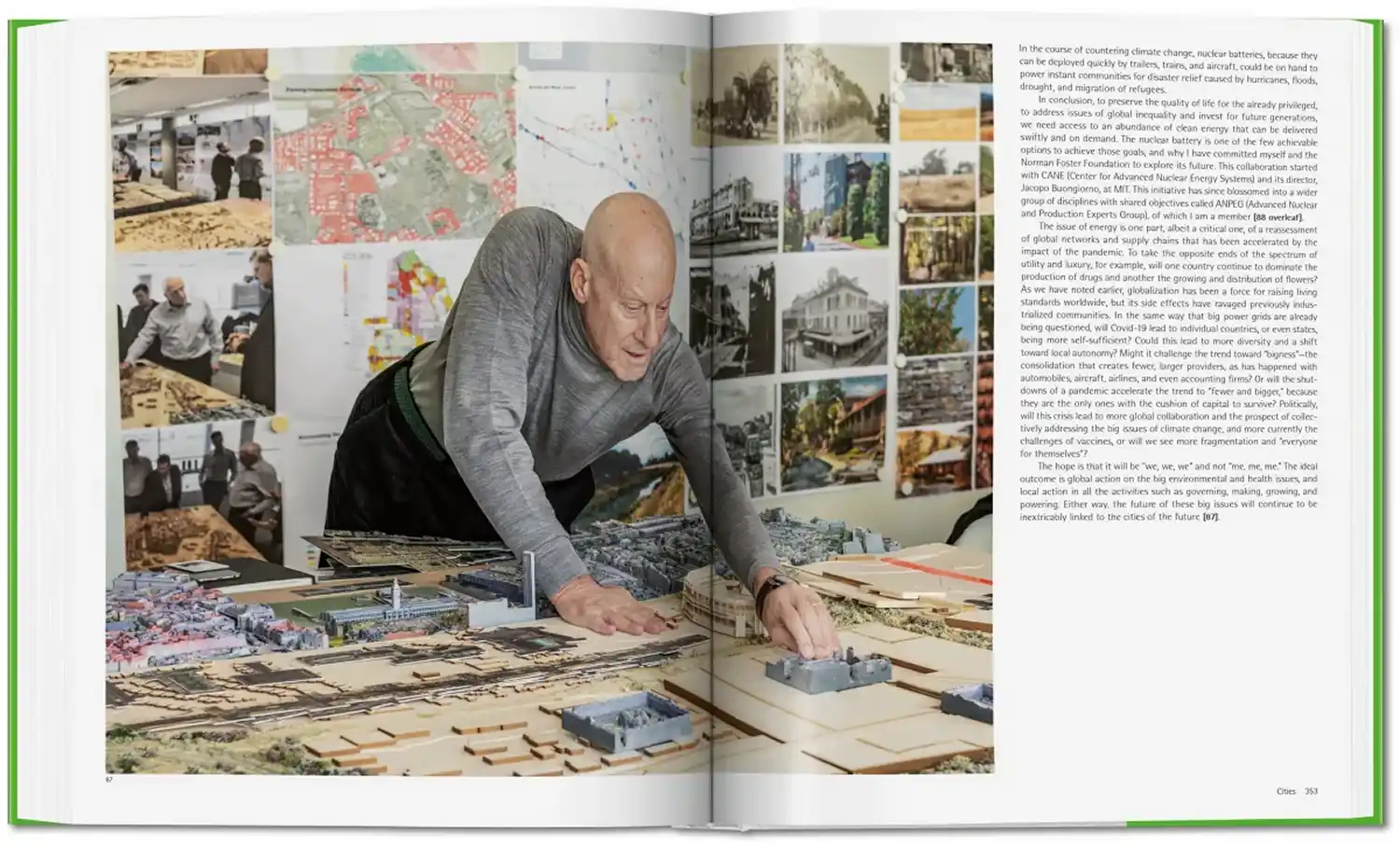
Photo: TASCHEN
Synthesis Instead of Style
Consistently, Networks avoids any form of heroization. Foster does not see himself as the creator of a form, but as part of a process. Collaboration and adaptation become visible as structural prerequisites. Even large projects do not appear as singular statements, but as the results of coordinated systems.
The design follows this logic. Images and sketches do not create a linear narrative, but a network of relations. Reading requires movement between different levels, not just attention to a textual flow.
In this way, Networks fulfills a dual function. It is both reflection and tool. On the one hand, it makes the thinking of one of the most influential architects of the present comprehensible. On the other, it formulates a model that extends beyond the individual. Architecture as a process of integration.
What becomes visible is not a signature in the classical sense, but a method. Buildings appear as the result of condensed relationships – technical and cultural. In the end, there is no closed theory, but an open structure. Networks does not explain what architecture is. It shows under which conditions it emerges.
Norman Foster. Networks. TASCHEN, 2026, 368 pages, €80.