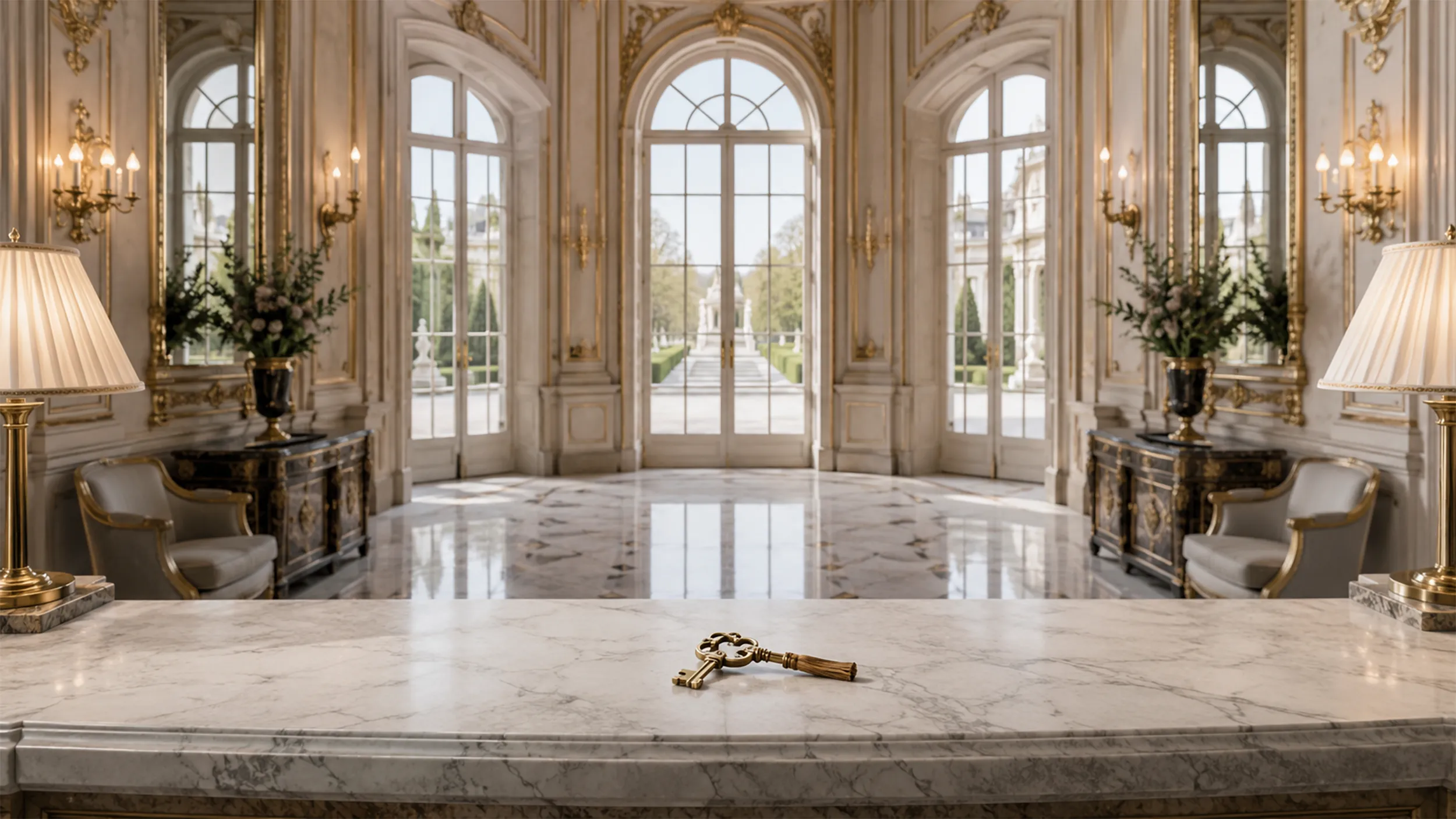

France’s “Palace” status shows how luxury hospitality can become a form of national self-description. Here, a hotel is not merely a business, but a place where service and cultural radiance acquire political meaning.
France possesses an ability that has largely been lost in Germany: it can institutionalise luxury without immediately having to justify it morally. While in Germany luxury is quickly suspected of being vulgar or socially indecent, in France it is treated as part of public representation. The state does not only assess monuments and cultural buildings, but also places where hospitality becomes part of a national image.
The Palace status is therefore more than an accolade for especially expensive hotels. It is a gesture of cultural policy. A hotel is not judged solely by whether it offers comfort at the highest level. What matters is whether it can tell a story in which a place becomes linked to a particular idea of French excellence. That is precisely the point: luxury is not left to the market.
The administration of aura
Aura rarely arises by accident. It must be allowed to emerge and, at the same time, be reliably protected. France understood this earlier than many other countries. A Palace is not simply a hotel with higher prices, but a stage on which national culture appears as a service. Spatial staging is not a secondary matter. It turns a stay into a carefully composed experience.
This is precisely where the Palace differs from luxury in its purest sense. It does not sell excess, but order. Every detail belongs to a larger arrangement. The guest is not paying only for a bed, but also for the certainty that beauty and distance are not accidental. In aesthetic terms, this form of luxury is authoritarian, because it tolerates little arbitrariness.
That is what makes Palace status so revealing. The French state certifies not only comfort, but a particular idea of the world. A hotel becomes an interface between private ownership and public effect. What is being honoured is not merely a building, but the idea that culture can be made inhabitable.
Germany knows the price, but rarely the prestige
A comparable system would be difficult to imagine in Germany. Not because there are no good hotels, but because the cultural logic is missing. Here, luxury is either described in technical terms or treated with social suspicion. People talk about facilities and efficiency. They rarely talk about splendour as a legitimate public category. Beauty remains a private matter; prestige is considered embarrassing. Excellence is usually recognised only once it can justify itself functionally.
This is no coincidence. After 1945, the Federal Republic developed a deep mistrust of representation. Much of that was historically understandable. Yet the necessary distance from the old language of power later became a general weakness in relation to form. Germany built correctly and administered solidly. France, by contrast, never entirely stopped wanting to make cultural superiority visible.
Palace status therefore also reveals a difference in the understanding of the state. France does not see culture only as the support of classical institutions, but as an economy of radiance. A top hotel does not remain trapped in the logic of private exclusivity. It becomes an export image. Anyone staying in a French Palace pays not only for service, but for a national idea of refinement.
The contradiction of the perfect image
This order contains its own contradiction. Many Palace hotels may still embody French elegance, but today they are part of global ownership structures. The national image is therefore often stabilised by foreign capital. The state certifies a cultural aura that, economically, is often no longer under national control.
That is precisely where the strength of the model becomes visible. In the globalised luxury economy, ownership is not the only thing that matters; interpretative authority matters too. Whoever decides what counts as the highest standard possesses cultural power. France does not merely sell rooms or façades. It defines the criteria by which luxury is measured.
Palace status thus becomes an instrument of symbolic authority. It says: not every expensive place is significant. Not every five-star hotel reaches cultural height. Prestige cannot be bought without submitting to an order. Precisely because luxury has become reproducible worldwide, this distinction gains weight.
The real lesson, then, does not lie in hospitality. It lies in a country’s ability to set standards. France insists that excellence must be more than comfort and capital. It requires an awareness of form that is institutionally secured. One can call that elitist. But one can also see it as a cultural consequence that has become rare today.
Germany would barely have a language for this. It would probably translate the term “prestige” into procedures until every trace of splendour had disappeared. France, by contrast, knows that prestige does not operate democratically, but hierarchically. That is exactly why it works.