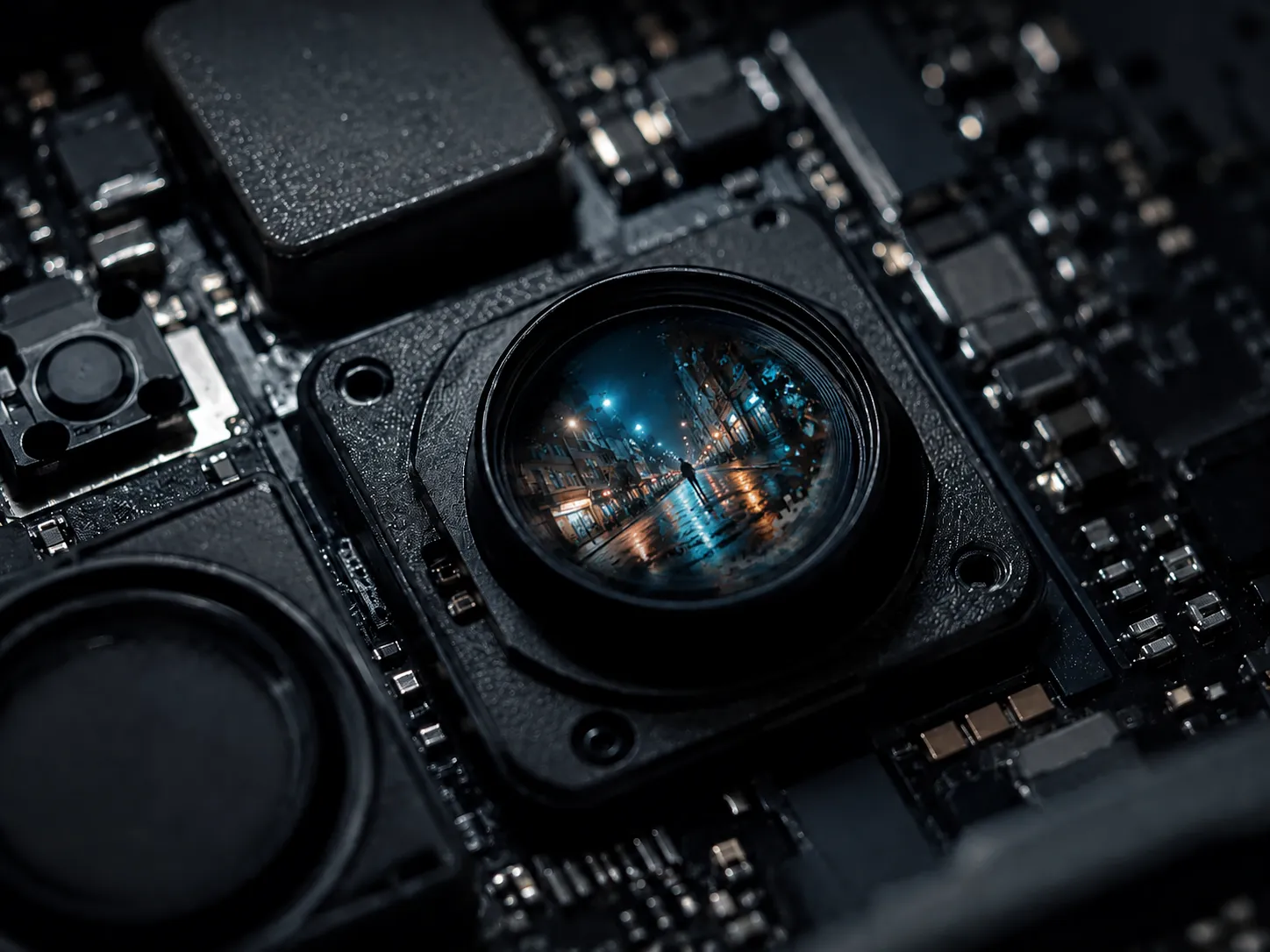

Artificial intelligence is changing photography at the very moment of capture. The photograph still appears to function as evidence, even though parts of its visibility may already be technically generated.
The crisis of photography is usually sought in the wrong places. It appears in the form of deepfakes or manipulated press images. Such cases are obvious and can therefore be turned into scandals. More decisive, however, is a less conspicuous shift: the camera is beginning not only to record light, but to plausibly supplement missing information. The question of truth is thus moving from the image-editing programme to the moment of capture.
Manipulation moves into the apparatus
The idea of computational photography is not new. Smartphones have for years combined several exposures, reduced noise and expanded dynamic range. For a long time, this could still be understood as a technical optimisation of the photographic apparatus. The camera made visible what the sensor captured only imperfectly. With generative and learning-based processes, however, the nature of this correction changes. The image is no longer merely improved. In certain places, it may contain information that no longer clearly originates from the scene itself.
A recent research paper describes precisely this problem. While camera images have traditionally been regarded as authentic, AI manipulations are usually assumed to occur only after the image has been taken. At the same time, deep-learning modules are increasingly being integrated directly into the image-processing technology of cameras. As a result, hallucinated visual content can already appear in the file that the user regards as the original camera image. The manipulation is therefore not added afterwards; it becomes part of the camera output.
This is more than a technical detail. The cultural authority of photography never rested on optical resemblance alone, but on a quiet chain of reference: something was in front of the camera, light fell on a sensor or film, and the image remained bound to that event. This bond was never absolute. Analogue photography, too, can stage or deceive. But its potential for deception remained tied to an act of capture. The new camera technology dissolves this boundary because it no longer draws a clear line between recording and generation.
Improvement becomes assertion
This development becomes particularly sensitive wherever improvements are semantically relevant. A brighter night shot is not yet an epistemic rupture. A smoothed sky changes little either. The situation is different when AI zoom supplements faces or object details that the sensor has not captured sufficiently. What emerges is no longer a neutrally improved photograph, but an image that asserts interpretable information. The distinction is crucial: removing noise means reducing interference. Making a previously unreadable number plate legible, by contrast, means producing a statement about the world.
As a result, the old distinction between original and edited image becomes obsolete. If an image has already been altered by neural processes at the moment it is saved, the rawness of the photograph can no longer be taken for granted. The user may believe they possess an unedited camera image, even though the decisive interventions have already taken place before any conscious editing. This is precisely what makes the development more dangerous than visible AI aesthetics. It is not the artificial look that undermines trust, but the continuation of the photographic look by other technical means.
The industry has an interest in selling this shift as convenience. Better night shots and sharper crops can easily be presented as progress. For the everyday user, that is even true. Most people do not want a documentary sensor record, but a usable image. This is where the cultural tension lies: photography increasingly fulfils expectations of legibility while its evidential force declines. The image becomes more successful as an image, but weaker as testimony.
Authenticity becomes a metadata question
The obvious answer is authentication. Some research approaches propose marking camera images at pixel level to show which areas were captured directly and which were altered or supplemented by computational processes. In that case, authenticity would no longer be a property of the whole image, but a local piece of information. A photograph would no longer appear as a unified testimony, but as a map of varying degrees of evidence.
Yet this solution also makes clear how far photography has already changed. Once an image requires an authenticity mask, its status is no longer self-evident. The camera no longer provides only an image, but also a claim about which parts of that image may still count as capture. Trust thus shifts from the photographic process to the technical infrastructure, and from visibility to the metadata layer.
For visual culture and journalism, this is not a marginal question. Many visual systems still rest on the assumption that a photographic image contains at least a residue of presence. That residue was never innocent, but it was effective. If cameras now begin not merely to register the world, but to complete it at the moment of registration, photography does not lose its aesthetic value. It loses something else: its quiet function as witness.